7 Best Singer Sewing Machines (October 2026)
The best Singer sewing machines include the Singer 4423 for mixed household projects, the Singer 4523 for learning garment sewing, and the Singer 4552 for layered fabric projects.
On this page (7 sections)
- Which is the best Singer sewing machine for your projects?
- What should you compare before choosing a Singer?
- How much heavy fabric work can these machines handle?
- How should you set up a Singer before the first project?
- Which common mistakes spoil otherwise simple seams?
- How do you care for a Singer between projects?
- Which Singer sewing machine should you choose?
The best Singer sewing machine for most people is the Singer 4423, which combines useful fabric adjustments with a one-step buttonhole. Choose the Singer 4523 if you want to limit sewing speed, or the Singer M1500 if simple repairs are your main goal.
The right machine should suit the work you expect to repeat: hemming pants, making garments, sewing cushion covers or adding decorative details. A longer stitch menu matters less than controls that help you finish those jobs.
If you're choosing between brands, see our Brother vs Singer sewing machine comparison. For a broader shortlist beyond Singer, read our best sewing machines guide.
Our picks at a glance
-
1

-
2

-
3

Which is the best Singer sewing machine for your projects?
The Singer 4423 is the strongest starting point for mixed household sewing, but a different model may fit a specific need better. The choices below separate fabric control, simpler setup and creative features so you can buy for your actual projects.
How we chose the best Singer sewing machines
We compared the controls, fabric adjustments, buttonhole methods and included tools that affect everyday sewing. The order reflects each machine's overall fit for this search; a lower-ranked model can still be the better choice for a narrow task.
We gave more weight to useful adjustments than decorative stitch totals. A machine for occasional mending needs a different feature mix from one used to make clothing or handle layered home décor.
| Product | Best for | Built-in stitches | Sewing speed | Buttonhole | Our score |
|---|---|---|---|---|---|
| Singer 4423 | mixed household projects | 23 | Up to 1,100 stitches per minute | One-step | 8.8 |
| Singer 4523 | learning garment sewing | 23 | Up to 1,000 stitches per minute | One-step | 8.0 |
| Singer 4552 | layered fabric projects | 32 | Up to 1,000 stitches per minute | One-step | 7.7 |
| Singer 4432 | frequent home sewing | 32 | Up to 1,100 stitches per minute | One-step | 7.6 |
| Singer M1500 | simple mending | 6 | Not specified | Four-step | 7.4 |
| Singer 4411 Pink | colorful craft spaces | 11 | Up to 1,100 stitches per minute | Four-step | 7.4 |
| Singer 6700C | decorative garment sewing | Up to 1,100 stitches per minute | Seven one-step styles | 7.3 |
Singer 4423
- 23 built-in stitches
- Adjustable presser foot pressure
- Extra-high presser foot lift
- One-step buttonhole
Choose this for clothing repairs, home décor and occasional heavier fabric work. Its fabric adjustments offer room to learn beyond basic seams.
Pros
- Adjustable pressure for different fabrics
- Extra-high lift accommodates layers
- Transparent bobbin cover
Cons
- 17.1 lb to move or store
- Choose the 4523 if setting a maximum speed matters
The Singer 4423 suits someone who wants one machine for varied household projects. Think cotton cushion covers, clothing repairs, simple garments and occasional denim work rather than a single specialty.
Its adjustable presser foot pressure helps you change how firmly the foot holds the fabric, while the extra-high lift gives you more room to position layers. Those are practical controls when your projects move between thin cloth and bulky hems.
The stitch range covers basic, stretch and decorative work, so you can learn useful techniques without choosing a computerized machine. Its free arm also helps you position a cuff or pant leg, provided the opening fits around it.
Choose it if you're willing to learn fabric adjustments as your skills grow. Skip it if setting a firm speed ceiling is a priority, or if you need only a machine for rare, simple repairs.
For the limits of thick seams and folded hems, read our guide to sewing denim and jeans on a home machine.
Singer 4523
- 23 built-in stitches
- Adjustable maximum speed
- Integrated needle threader
- Blind hem foot included
A strong fit for learning curves, corners and clothing construction. Set a speed ceiling while keeping adjustable stitch settings for different projects.
Pros
- Maximum speed can be limited
- Adjustable presser foot pressure
- Free arm for cuffs and hems
Cons
- Fewer stitch choices than the 4552
- Walking foot is not among its included feet
The Singer 4523 is the better fit for someone who wants more control while learning garment construction. Its maximum speed setting lets you keep the pace down around a neckline or pocket corner.
That setting matters even if you rarely sew fast. It gives you a repeatable speed limit while you focus on seam allowance, fabric position and stopping at the right point.
The included blind hem foot is useful if you plan to learn less visible hems on suitable fabrics. Adjustable stitch length and width also let you change the seam setup instead of accepting fixed settings.
Choose the 4523 for a mix of repairs and clothing projects where careful steering matters. Skip it if you already know you'll need a walking foot, non-stick foot and more decorative choices, since the next model bundles those extras.
Its drop feed supports free-motion techniques, but those still take practice. Lowering the feed dogs means you take responsibility for moving the fabric and keeping stitches reasonably even.
Singer 4552
- 32 built-in stitches
- Adjustable maximum speed
- Walking and non-stick feet
- Clearance plate included
Pick this for projects that call for different feeding tools. The accessory bundle adds useful options for layers, sticky surfaces and uneven seam transitions.
Pros
- Walking and non-stick feet included
- Heavy duty needles and clearance plate
- Drop feed for free-motion work
Cons
- Extra accessories need practice
- More equipment than occasional repairs require
The Singer 4552 makes the most sense for layered projects that need more than an all-purpose foot. Its walking foot, non-stick foot and clearance plate give you tools for different feeding problems.
A walking foot can help layers travel together, while a non-stick foot can help with surfaces that drag against a standard foot. A clearance plate helps keep the foot more level when crossing a bulky seam.
Those accessories solve different problems, so don't treat them as interchangeable. Read our guide to what a walking foot does if you're unsure which projects call for one.
Choose this model if you plan to make layered home décor, experiment with tricky surfaces or learn more feeding techniques. Skip it for occasional straight seams if the extra feet would stay in storage.
The included heavy duty needles are useful supplies, but needle choice must still match the fabric and thread. For alternatives with different feature mixes, see our best heavy duty sewing machines.
Singer 4432

- 32 built-in stitches
- Adjustable stitch length and width
- Adjustable presser foot pressure
- Free arm
A dial-based option for regular garment, décor and repair work. Its wider stitch selection suits buyers who want more choices without screen-based controls.
Pros
- Utility, stretch and decorative options
- Needle threader and top drop-in bobbin
- Quilting guide and dust cover included
Cons
- Walking foot is not included
- Choose the 4552 if you want a maximum speed setting
The Singer 4432 suits a regular home sewist who wants a wider stitch choice with dial-based controls. It covers practical seams and repairs while leaving room for stretch and decorative work.
Its adjustable stitch length, width and presser foot pressure let you adapt the setup to the project. That matters when a neat topstitched edge needs a different approach from a flexible seam.
Choose it if you already feel comfortable managing a foot pedal and expect to use more than the basic stitches. For long, straightforward seams, its high maximum speed gives you capacity to work faster as your control improves.
Skip it if your main concern is limiting speed while you learn. The 4523 or 4552 is a clearer match for that need, and the latter also includes a walking foot.
The 4432's included quilting guide helps with spacing, but it doesn't feed fabric layers for you. If jeans are your main project, compare our best sewing machines for denim before deciding.
Singer M1500

- 6 built-in stitches
- Preset stitch length and width
- Marked threading guides
- Portable design
A straightforward choice for occasional repairs and simple crafts. Preset stitch settings reduce setup choices but limit how much you can adjust a seam.
Pros
- Simple stitch selector dial
- Preset settings reduce decisions
- Designed for portability
Cons
- Cannot fine-tune stitch length and width
- Buttonholes need four stages
The Singer M1500 suits occasional mending and simple projects with few setup decisions. Its stitch dial and preset length and width keep the controls straightforward.
That simplicity is useful for learning to guide fabric, follow a seam allowance and finish a basic repair. The tradeoff is that you can't fine-tune those stitch dimensions when a fabric or technique needs a different setting.
Choose it for simple woven-fabric projects, light crafts and routine repairs. Singer also designs it for portability, which suits someone who stores the machine between sessions or takes it to class.
Skip it if you expect to sew thick folded hems regularly or want broad control over stitch settings. It also asks you to manage separate stages when making a buttonhole, which matters more if you plan to sew shirts.
Before buying a first machine, choose a few starter projects and work backward from their needs. Our best sewing machines for beginners guide explains other ways to balance simplicity and room to grow.
Singer 4411 Pink
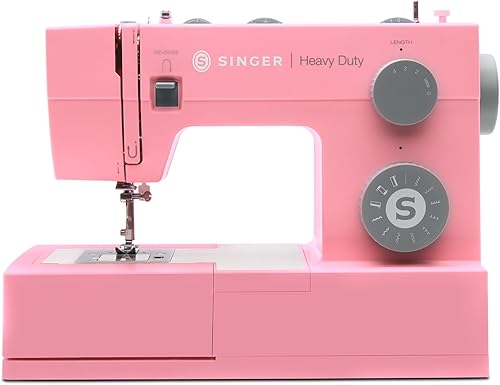
- 11 built-in stitches
- Pink finish
- Metal frame
- Four presser feet included
Choose this if its pink finish suits your sewing space and you mainly need essential stitches. It pairs a smaller stitch selection with heavy duty construction.
Pros
- Distinctive pink finish
- Stainless steel bedplate
- Quilting guide and soft cover included
Cons
- Four-step buttonhole
- Smaller stitch selection than the 4432
The Singer 4411 Pink suits someone who wants essential stitches in a colorful sewing space. Its finish is a valid preference if you like leaving your machine out, but the controls should still fit your projects.
The smaller stitch selection makes sense for practical seams, repairs and basic creative work. You don't need a long decorative menu to make useful household items or alter simple garments.
Choose it if the pink design appeals to you and you're comfortable managing a four-stage buttonhole. The included general-purpose, zipper, buttonhole and button sewing feet cover several common tasks.
Skip it if you'll make rows of buttonholes often, since a one-step model reduces the stages you manage. Buyers who want lettering or extensive decorative options should also look elsewhere in this group.
Singer describes it as suitable for heavier fabrics, including leather. Match any such project to a domestic machine's limits, and don't assume the heavy duty label makes every thick seam suitable.
Singer 6700C
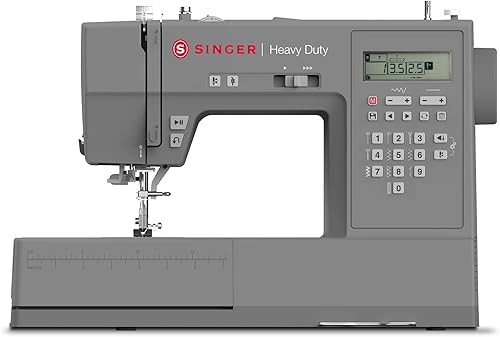
- 411 stitch applications
- LCD screen and lettering
- Adjustable maximum speed
- Ten presser feet included
The computerized choice for lettering, varied buttonholes and decorative work. Its screen shows stitch settings, while the foot collection supports several finishing techniques.
Pros
- Lettering font included
- Screen displays stitch length and width
- Walking, satin stitch and open toe feet included
Cons
- More controls to learn for basic repairs
- Built-in lettering is not custom embroidery
The Singer 6700C is the choice for decorative sewing with screen-based stitch settings. Its built-in lettering and varied buttonholes are useful if you want to personalize projects or explore garment details.
The LCD shows the selected stitch and its length and width settings. That makes it easier to check your setup before sewing, particularly when switching between utility and decorative work.
Its ten-foot collection includes tools for satin stitching, cording and more visible work around the needle. Choose it if you have projects for those techniques and want to learn what each foot does.
Skip it if you mainly shorten curtains or close split seams. A large stitch library won't improve a basic seam by itself, and it adds choices you may never need.
Built-in lettering also isn't a substitute for custom embroidery designs. If digital controls appeal to you, our guide to computerized sewing machines compares more options across brands.
What should you compare before choosing a Singer?
Compare project needs, speed control and fabric adjustments before decorative stitch totals. Our broader sewing machine buying guide can help if you're still deciding which features matter for home sewing.
Start with three projects you will actually make
Write down three near-term projects and the fabric each needs. Cotton pillow covers, stretch clothing and denim alterations call for different needles, seam methods and feeding choices.
For each project, identify the hardest step rather than just the longest seam. That might be turning a tight curve, sewing a buttonhole or crossing several folded layers at a hem.
Buy for those steps first. A machine that helps you manage the awkward part of a project is more useful than one chosen for features you'll rarely touch.
Separate built-in stitches from stitch applications
Stitch applications are uses for stitches, not separate stitch patterns. The 4423 and 4523 each have 23 built-in stitches and 97 applications; the 4552 and 4432 each have 32 stitches and 110 applications.
For everyday sewing, straight stitch, zigzag and an appropriate stretch option usually matter more than a large decorative menu. Look at the patterns you'll use and whether you can adjust them for your work.
Don't choose the biggest number simply to avoid outgrowing a machine. Fabric control, compatible accessories and your interest in learning new techniques also shape how far you can take it.
Decide how much control you want over speed
A maximum speed setting is useful if sudden acceleration makes you lose your seam line. It sets a ceiling, while your foot still manages the pace within that limit.
Top speed matters most on long, uncomplicated seams after you have good control. It is a poor shortcut around corners, thick transitions or details where stopping accurately matters.
For a first machine, consider how comfortable you are using a foot pedal. Someone who wants a steady, limited pace may prefer the 4523 even though the 4423 ranks higher overall.
Match buttonholes to your sewing plans
A one-step buttonhole reduces the stages you manage, which is useful for garments with several closures. A four-step process can still suit occasional use if you mark carefully and practice the sequence.
Either method needs a trial buttonhole on matching scraps with the same interfacing and layers as the project. Check the button fit before opening the finished hole.
Choose controls you want to learn
Dials suit buyers who prefer adjusting settings directly, while screen-based controls help display stitch choices and dimensions. Neither approach removes the need to understand thread, needles and fabric.
Read what a computerized sewing machine is if the terms are unfamiliar. Choose digital features because you want their functions, rather than assuming they automatically make sewing easier.
How much heavy fabric work can these machines handle?
A domestic heavy duty Singer suits some denim, canvas and layered household projects, but thickness at the seam matters more than the fabric name. A flat piece of denim is a different challenge from a folded hem crossing a side seam.
Presser foot clearance only tells you whether you can position the work. It doesn't prove the machine can feed and stitch that stack cleanly.
Before starting, fold scraps to match the thickest part of the real project. Use the intended needle and thread, then check that the machine feeds the stack without force.
Stop if the needle struggles, deflects or strikes near the foot or plate. Pulling the fabric or repeatedly driving the needle into a resistant seam can damage the work and the machine.
Frequent dense stacks, thick straps or substantial leather construction call for a more specialized machine assessment. Read what a heavy duty sewing machine is before treating that label as a promise about every material.
How should you set up a Singer before the first project?
Start with the model's manual, suitable supplies and matching fabric scraps. A careful first setup helps you separate a threading problem from a setting that needs adjustment.
Prepare the table and supplies
Use a firm table with room behind and beside the needle for the fabric to rest. Keep the pedal where you can reach it comfortably without stretching your leg or shifting your seat.
Have appropriate thread, compatible bobbins, fabric scissors and spare needles ready. The included accessory kit is a starting point, so check the manual before buying replacement bobbins or feet.
Install the needle and thread correctly
Switch off the machine before changing the needle or foot. Fit the needle in the direction and to the depth shown in the manual, then tighten it securely.
Thread the upper path with the presser foot raised so the thread can enter the tension system. Follow the model's bobbin direction and thread path rather than copying a different machine.
Use the needle threader according to its instructions and needle-size limits. If it resists, check alignment instead of forcing its small parts.
Sew a practice seam that matches the project
Use scraps with the same number of layers as your planned seam. Begin with the recommended stitch and tension settings, then inspect both sides of the fabric.
Change one setting at a time and keep a small labeled sample if you find a useful combination. That gives you a reference when returning to the same fabric later.
Learn starts, stops and corners
Lower the presser foot before sewing and guide the fabric without pulling it. Let the feed system move the work while you keep the edge aligned with your seam guide.
At a corner, stop with the needle in the fabric before lifting the foot and turning the work. Practice this slowly until you can stop close to your intended turning point.
Which common mistakes spoil otherwise simple seams?
The most common avoidable problems come from incorrect threading, unsuitable needles and forcing the fabric. Check those before making large tension changes.
Using one needle for every material
Needle type and size should match the fabric and thread. A needle suitable for woven cotton may be the wrong choice for a knit or a dense denim hem.
Replace a bent, blunt or damaged needle promptly. If stitches suddenly skip or the machine starts making an unusual impact sound, stop and inspect the needle before continuing.
Adjusting tension before checking threading
Loops under the fabric can begin with an upper-thread problem. Rethread carefully, check the bobbin installation and confirm the presser foot is down before changing the tension dial.
Make small changes on scraps and inspect both sides after each change. A drastic adjustment can hide the original problem and create another one.
Pulling fabric through a thick seam
Pulling can bend the needle and distort the seam. Support the weight of the project and use an appropriate feeding aid where needed.
If the work won't advance without force, stop and reassess the layers, foot position and needle. More pedal pressure doesn't solve a poor setup.
Expecting one machine to perform every finish
A zigzag edge finish can help control fraying, but it won't produce the same result as a serger. Likewise, decorative stitches and built-in lettering have limits compared with dedicated embroidery equipment.
Choose projects around the machine's functions and learn the right technique for each finish. Extra stitch choices don't replace the correct tool.
How do you care for a Singer between projects?
Keep the machine clean, covered and supplied with sound needles, following its manual for maintenance. Regular attention to lint and threading is more useful than adding oil without checking the instructions.
Brush lint from accessible bobbin and feed areas with the power disconnected. Avoid blowing debris farther into the machine, and remove only the parts the manual allows you to access.
Oil only where the manual directs, using the recommended type. Different designs have different care needs, so a routine for an older Singer may not suit a newer model.
Store feet, bobbins and needles in labeled spaces so you don't mix incompatible parts. Cover the machine once you're finished and keep its cords away from places where they can be pinched.
If the machine jams, stop rather than pressing the pedal again. Free the work carefully, inspect the thread path and needle, then try a scrap seam before returning to the project.
Which Singer sewing machine should you choose?
Choose the best Singer sewing machine for your hardest routine task, then check whether its everyday controls suit you. Use these decision rules to narrow the group.
- Choose the 4423 for a broad mix of household repairs, garments and occasional heavier fabric work.
- Choose the 4523 if setting a maximum speed will help you learn or sew detailed sections.
- Choose the 4552 if layered projects justify its walking foot, non-stick foot and clearance plate.
- Choose the 4432 if you want more stitch choices with familiar dial-based adjustments.
- Choose the M1500 for simple repairs and fewer setup decisions.
- Choose the 4411 Pink if essential stitches meet your needs and the color matters to your sewing space.
- Choose the 6700C if lettering, decorative work and screen-based settings are part of your plans.
Before ordering, name the first project you'll make and the hardest seam it contains. If you can't connect a feature to that project or the next few, it probably shouldn't decide your choice.
For a wider view of controls and brand options, continue with our sewing machine brands comparison.
Our top 3 picks at a glance
-
1
-
2
-
3
Frequently asked questions
Which Singer sewing machine is best for beginners?
The Singer M1500 suits beginners who want simple mending with few settings to manage. Choose the Singer 4523 instead if you want to learn garment construction and set a maximum sewing speed.
The better starting point depends on your projects: fewer choices simplify setup, while adjustable controls leave more room to grow.
Which Singer machine is best for denim?
The Singer 4423 is our first choice for occasional denim work because its adjustable presser foot pressure and extra-high lift help with fabric layers. Choose the Singer 4552 if you also want its walking foot and clearance plate.
Use a denim needle and practice on scraps matching the actual seam thickness.
What is the difference between Singer 4423 and 4432?
The Singer 4423 has 23 built-in stitches, while the Singer 4432 has 32. Both provide a one-step buttonhole, adjustable presser foot pressure, a needle threader and a top drop-in bobbin.
Choose the 4432 for its wider stitch selection; choose the 4423 if your work centers on common seams, repairs and hems.
Should you choose a mechanical or computerized Singer?
Choose a mechanical Singer if you prefer dials and mainly sew seams, hems and repairs. Choose the computerized Singer 6700C if you want built-in lettering, more decorative choices and screen-based settings.
Either type still needs correct threading, a suitable needle and practice with your fabric.