Brother CS5055 Computerized Sewing Machine Review: Worth It? (October 2026)
The Brother CS5055 suits home sewers who want computerized stitch selection for garment sewing, decorative work and repairs. Choose it for varied projects; consider the XM2701 for basic alterations or the XR3774 for its included wide table.
On this page (9 sections)
- What does the Brother CS5055 offer?
- How do the Brother CS5055 alternatives compare?
- Is computerized stitch selection useful for your projects?
- Which stitches will you actually use?
- Is the CS5055 suitable for denim and other thick fabric?
- How should you set up the CS5055?
- How do you prevent jams and uneven seams?
- What care does the machine need?
- Which Brother sewing machine should you choose?
The Brother CS5055 is a good fit for varied home sewing, especially if you want computerized stitch selection for garments, repairs and decorative projects. It makes the most sense when you'll use several stitch types rather than sew the same straight seam each time.
Its appeal is flexibility: you can learn basic construction, then add decorative details without choosing another machine solely for more stitch options. For routine alterations, a free arm or a particular sewing foot may matter more.
What does the Brother CS5055 offer?
The CS5055 gives you 60 built-in stitches and 7 one-step auto-size buttonhole styles, selected with an LCD display. Its stitch range covers utility, decorative and heirloom functions.
Brother CS5055
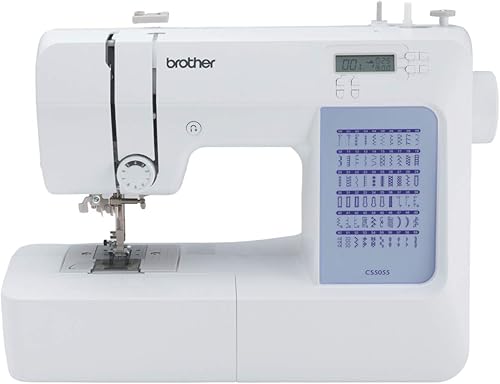
- 60 built-in stitches
- 7 one-step auto-size buttonholes
- LCD display
- 7 sewing feet
A computerized choice for sewers who mix garment repairs with decorative and heirloom-style projects. Choose it when stitch variety matters more than a basic repair setup.
Pros
- Utility, decorative and heirloom stitch choices
- Multiple auto-size buttonhole styles
- Automatic needle threader and drop-in top bobbin
- Larger needle-to-arm workspace
Cons
- Extra stitch choices add little for straight-seam repairs
- Intended for US use at 120 volts
The package includes 7 sewing feet, 4 bobbins and a needle set. An automatic needle threader, drop-in top bobbin and LED-lit work area help with the steps you'll repeat each sewing session.
A metal frame and fixed needle bar are part of its construction. Brother says the fixed needle bar helps limit movement for cleaner stitching, but your needle, thread and fabric handling still affect the finished seam.
Who should buy the Brother CS5055?
Buy it if your plans include garment construction and decorative sewing, with occasional repairs between larger projects. Multiple buttonhole styles are useful when you want different finishes for shirts, dresses or other button-front garments.
Skip it if your project list is mostly shortened pants, repaired seams and simple household hems. You can complete those jobs with a much smaller stitch menu, so choose around access to the fabric and the feet you'll use.
It's also worth separating sewing from decoration. A decorative stitch can embellish fabric, but a larger stitch menu does not replace learning seam allowances, pressing and accurate cutting.
How do the Brother CS5055 alternatives compare?
Choose among these models by your main sewing task, rather than by stitch count alone. The alternatives offer different reasons to buy: access around sleeves, a focused accessory set or a table for fabric support.
| Model | Built-in stitches | Buttonholes | Notable features |
|---|---|---|---|
| Brother CS5055 | 60 | 7 one-step auto-size styles | LCD display, larger needle-to-arm workspace |
| Brother XM2701 | 27 | 1 one-step auto-size style | Free arm, 6 feet |
| Brother XM3700 | 37 | 1 one-step auto-size style | Free arm, 5 feet |
| Brother XR3774 | 37 | 1-step buttonhole | Wide table, 8 feet, machine cover |
The Brother sewing machine comparison covers more models across the brand. For another computerized option to compare before deciding, read our Brother CS7000X review.
Brother XM2701: choose it for clothing alterations
The XM2701 suits someone whose sewing basket mainly contains loose hems, damaged seams and clothes that need adjusting. Its free arm helps you position cuffs, sleeves and pant legs without leaving the whole garment spread across a flat bed.
Its included feet cover buttonholes, zippers, zigzag sewing, narrow hems, blind stitching and button sewing. That task-based set is a stronger reason to choose it than simply wanting fewer controls to learn.
Skip it if decorative stitch exploration and several buttonhole looks are central to your plans. Those are clearer reasons to choose the CS5055.
Brother XM3700: choose it for small garment pieces
The XM3700 suits sewers making baby clothes or working around narrow sleeves and cuffs. Sliding off its accessory storage compartment exposes the free arm, while the built-in light helps you see the sewing area.
Its feet cover zigzag sewing, zippers, blind stitching, buttonholes and button sewing. Choose it when those tasks and its stitch selection match your plans.
Skip it if you specifically want the XM2701's included narrow hemmer foot or the XR3774's wide table. Decide which accessory you'll use before treating the XM3700 as an automatic middle choice.
Brother XR3774: choose it for supported quilt work
The XR3774 makes sense for beginning quilters who want an included wide table. Supporting fabric beside the needle helps keep its weight from pulling against your seam.
Its 8 sewing feet and machine cover round out a package aimed at sewing and quilting. Check that your desk can hold the table and the fabric around it.
Skip it if most of your work involves small repairs or decorative garment details. A wide table also does not create more room between the needle and the machine's arm, which matters when turning a bulky quilt.
Is computerized stitch selection useful for your projects?
Computerized selection is useful when you switch among stitch types for different tasks. The CS5055's display gives you a place to check your selection, but you still need to match the foot and settings to the job.
Think through your next 3 projects before choosing. A shirt with buttonholes, a decorated cushion and a repaired garment give you more reasons to explore its functions than 3 sets of straight curtain hems.
If you're unsure which control style you prefer, our guide to computerized versus mechanical sewing machines explains the trade-offs. Focus on how you want to select and adjust stitches during ordinary work.
Which stitches will you actually use?
Start with straight stitch, zigzag and the stitch your fabric needs, then add decorative choices for a specific purpose. Learning a few useful settings well is more valuable than trying every pattern immediately.
For woven fabric, straight stitch handles many construction seams. For stretchy fabric, choose a suitable stretch stitch and needle so the seam can move with the material.
Use decorative stitches on scraps before adding them to a garment. Thin fabric may need stabilizer to keep dense stitching from puckering, so practice with the same layers you plan to sew.
Buttonholes deserve their own sample. Sew one through matching fabric and interfacing, check the button fit, then mark the finished garment.
A one-step buttonhole simplifies the sequence, but placement still depends on careful measuring. Keep each mark consistent and follow the manual's directions for the buttonhole foot.
Is the CS5055 suitable for denim and other thick fabric?
The CS5055 is an option for occasional denim sewing, based on Brother's description of its ability to handle denim and tweed. Choose around the thickest part of your project, not the fabric name alone.
A flat denim patch and a folded jeans hem place different demands on the needle and feed system. Several seam allowances crossing at one point can create a hard step for the presser foot to climb.
Use a needle suited to the fabric and slow down at bulky crossings. Keep the fabric supported and guide it lightly rather than pulling it through or forcing the needle into a dense stack.
Stop if the needle bends, the machine stalls or the fabric will not feed. Repeated strain is a reason to change the method or reconsider whether the project belongs on this machine.
For frequent jeans work, read our guide to sewing denim and jeans on a home machine. It explains how layer count and seam bulk change the job.
How should you set up the CS5055?
Set it on a stable table with room for your fabric, then follow the manual's threading and bobbin steps in order. A rushed setup can cause trouble that looks like a machine fault.
The machine measures 17 in wide, 7 in deep and 12 in high, and weighs 10.5 lb. Leave room behind it for fabric to move without catching on a wall or dropping heavily over the table edge.
The larger needle-to-arm workspace helps you handle wider pieces. Support quilts and other large projects beyond the machine bed so their weight does not drag the seam sideways.
For your first session:
- Install a suitable needle fully, facing the direction shown in the manual.
- Fit the correct bobbin type and follow the marked thread path.
- Raise the presser foot while threading the upper path so the thread can seat correctly.
- Attach the foot required for your chosen stitch.
- Sew a sample using the same fabric layers as your project.
Keep the manual nearby while learning the controls. Sewing several short practice seams is more useful than starting with a complicated garment.
This model is intended for US use at 120 volts. Brother warns that other use or sale may void the warranty, so confirm suitability with Brother before planning to use it elsewhere.
How do you prevent jams and uneven seams?
Prevent many stitch problems with correct threading, a suitable needle and light fabric handling. Change one thing at a time so you can see what solves the problem.
Rethread before making large tension changes
If loops or tangled thread appear, stop and rethread both the upper path and bobbin according to the manual. Check that the presser foot is lowered before you begin sewing.
Do not assume thread under the fabric means the bobbin tension needs adjustment. An upper thread that missed part of its path can also cause loops underneath.
If tangles continue, follow our guide to why a sewing machine keeps jamming. Avoid repeatedly sewing over a fault, which can pack more thread into the bobbin area.
Guide the fabric instead of pulling it
Let the feed system move the fabric while your hands keep it aligned. Pulling from behind can bend the needle and distort the seam.
Keep seam allowances even by watching the guide beside the foot rather than staring only at the needle. Pause with the fabric supported when you need to reposition a large piece.
Check foot clearance after changing stitches
A foot used for one task may not suit a wider stitch. Follow the manual's foot guidance and turn the handwheel as directed to check clearance before sewing.
This is especially useful after switching from straight stitching to zigzag or decorative work. A needle striking the foot is a setup problem to correct immediately.
What care does the machine need?
Keep the needle area and bobbin area free of lint, and follow the manual's maintenance directions. Regular cleaning is especially useful after fabrics that shed fibers.
Switch off and unplug the machine before cleaning or changing the needle. Use the access steps and cleaning tools Brother recommends rather than pushing lint deeper into the mechanism.
Replace a bent or damaged needle promptly. A dull needle can cause poor stitching even when the threading and settings are correct.
Do not add oil unless the manual directs you to a specific point. Household oils and guesses about lubrication can create new problems.
Cover the machine between sessions to limit dust. Store feet, needles and bobbins where you can identify them easily, rather than mixing similar parts from different machines.
Which Brother sewing machine should you choose?
Choose the Brother CS5055 for varied sewing with decorative work, and choose the XM2701 when everyday alterations are your main goal. The XM3700 suits small garment projects, while the XR3774 makes sense when an included wide table will help your quilting setup.
Before ordering, name your first project and its hardest step. Buttonholes, a narrow sleeve, a bulky hem and a wide quilt each point to different needs.
Use our home sewing machine buying guide to check those needs against the controls, fabric demands and accessories that matter to you. If you want to stay within the brand, compare our Brother sewing machine picks with that project in mind.
Frequently asked questions
Is the Brother CS5055 good for beginners?
Yes, the Brother CS5055 suits beginners who want to learn garment sewing and decorative work on one machine. The automatic needle threader and drop-in top bobbin help with setup.
Start with straight seams and basic stitch settings, then explore other functions as your projects require them.
How many stitches does the Brother CS5055 have?
The Brother CS5055 has 60 built-in stitches covering utility, decorative and heirloom functions, plus 7 one-step auto-size buttonhole styles. Choose it if those options match projects you plan to make.
For simple repairs, needle choice, threading and fabric handling matter more than the size of the stitch menu.
Can the Brother CS5055 sew thick fabric?
Brother describes the CS5055 as suitable for denim, tweed and other thick fabrics. Judge each project by its thickest seam, since folded hems and seam intersections can be much bulkier than a flat piece.
Use the right needle, sew slowly and stop if the machine struggles to feed.
What is the difference between the Brother CS5055 and XM2701?
The CS5055 offers computerized stitch selection, a wider stitch menu and more buttonhole styles. The XM2701 has fewer stitch choices and a free arm for cuffs, sleeves and pant legs.
Choose the CS5055 for decorative variety or the XM2701 when everyday clothing alterations are your main task.