6 Best Sewing Machines for Quilting (October 2026)
The best sewing machines for quilting include the Brother CS7000X for first quilt projects, the Brother XR9550 for mixed sewing projects, and the Brother HC1850 for learning free-motion quilting.
On this page (7 sections)
- Which sewing machines for quilting suit different projects?
- How should you use this quilting machine comparison?
- How do you choose the best sewing machine for quilting?
- How should you set up a machine for your first quilt?
- Which common mistakes make quilting harder?
- How do you care for a machine used for quilting?
- Which is the best sewing machine for quilting for your next project?
The Brother CS7000X is the best sewing machine for quilting for most home quilters because it combines useful workspace with a wide table and quilt guide. Choose the Brother CP100X for straight-line quilt finishing or the Brother HC1850 for learning free-motion quilting.
The right choice depends on which part of quilt making you want to do. Joining small fabric pieces needs accurate seams; stitching through a quilt top, batting and backing also needs space and layer control.
Start with our complete home sewing machine buying guide if this will be your first machine. Our best sewing machines guide covers choices for other kinds of sewing.
Our picks at a glance
-
1
-
2

-
3

Which sewing machines for quilting suit different projects?
Choose the CS7000X for a first quilting setup, then compare alternatives by sewing method. A machine for decorative quilt borders serves a different need from one bought mainly to sew straight rows through quilt layers.
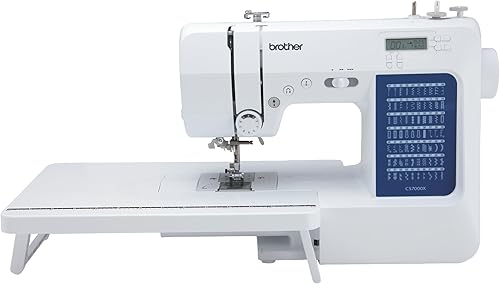
Brother CS7000X
- Large needle-to-arm workspace
- Wide table and quilt guide
- 70 built-in stitches
- 10 sewing feet
The CS7000X suits quilters building a first home setup, with room beside the needle and support beneath the fabric. Its quilt guide also helps with evenly spaced rows.
Pros
- Wide table and quilt guide included
- Large needle-to-arm workspace
- Protective hard case included
Cons
- Exact needle-to-arm measurement needs checking for bulky projects
- Intended for 120 V use in the US
The Brother CS7000X suits a quilter who wants to make blocks, assemble quilt tops and handle smaller finished quilts on one machine. Its large needle-to-arm workspace is the main reason to choose it over a machine bought chiefly for decorative stitches.
The detachable wide table supports fabric around the sewing area, while the quilt guide helps maintain spacing between rows. Neither removes the need to support the rest of the quilt on your work surface.
Its 70 built-in stitches cover utility, decorative, heirloom and quilting functions. An LCD display, automatic needle threader and drop-in top bobbin give you practical setup features without making stitch variety the main attraction.
Choose it if you're building a quilting workspace and want useful accessories from the start. Its protective hard case also gives you a cover for storage between projects.
Skip it as an automatic choice for large bed quilts until you've checked the actual clearance you need. If free-motion work is your main goal, the XR9550 and HC1850 offer clearly identified features for that method.
Brother XR9550
- 165 built-in stitches
- Wide table
- 8 sewing and quilting feet
- Drop feed for free-motion quilting
Choose the XR9550 for a mix of quilt work, garments and decorative sewing. Drop feed supports free-motion work, while alphanumeric stitches add lettering options.
Pros
- Drop feed for free-motion quilting
- Wide table and protective hard cover included
- Alphanumeric stitches included
Cons
- Walking foot compatibility needs checking if adding one
- Intended for 120 V use in the US
The Brother XR9550 suits someone who switches between quilts, clothing and decorative projects. Drop feed for free-motion quilting gives it a clear role beyond block construction and straight seams.
Its 165 built-in stitches include 110 sewing stitches and 55 alphanumeric stitches. That mix makes sense if you want lettering and decorative details as well as the utility stitches used for everyday sewing.
The LCD screen shows stitch choices and settings, and the free arm serves cuffs and sleeves when you're working on garments. A wide table and 8 sewing and quilting feet support the quilting side of that mixed workload.
Choose it if quilting is one part of your sewing rather than your only task. Before starting free-motion work, follow the manual for the correct foot and feed setup rather than assuming drop feed is the only change required.
Skip it if your next project is mostly straight-line quilting and you want a clearly identified walking foot included. Keep the Styrofoam lining inside the hard cover, as Brother instructs.
Brother HC1850
- 185 built-in stitches
- Adjustable sewing speed
- Spring action quilting foot
- Free-motion quilting capability
The HC1850 pairs a spring action quilting foot with adjustable speed for quilters learning to guide fabric by hand. It also supports basic monogramming.
Pros
- Spring action quilting foot included
- Adjustable sewing speed
- Built-in stitch reference flip-chart
Cons
- Walking foot compatibility needs checking if adding one
- Intended for 120 V AC use in the US
The Brother HC1850 is a focused choice for learning free-motion quilting because it combines that capability with a spring action quilting foot and adjustable sewing speed. Those features address the method you want to learn.
Free-motion quilting asks you to coordinate your hands with the needle's pace. A speed setting gives you a repeatable starting point while you practice moving a small quilt sandwich through simple curves.
The machine also includes a wide table, a backlit LCD and a stitch reference flip-chart. Its 185 built-in stitches include 55 alphanumeric stitches for basic monogramming, so it can serve decorative projects between quilts.
Choose it if you want to explore curves, loops and other guided-by-hand designs while keeping general sewing options available. At 10.1 pounds, it is also worth considering if you move your machine between a shelf and a worktable.
Skip it if your immediate goal is straight rows and an included walking foot is essential. The CP100X addresses that need more directly, without making free-motion work the reason to buy.
Brother CP100X

- Walking and quarter-inch piecing feet
- Wide table and quilt guide
- 100 built-in stitches
- Adjustable sewing speed
The CP100X suits quilters who want to piece blocks and finish quilts with straight rows. Its included walking foot, quarter-inch piecing foot and quilt guide serve those tasks.
Pros
- Walking and quarter-inch piecing feet included
- Wide table and quilt guide included
- Adjustable sewing speed
Cons
- Cannot monogram despite the included monogramming foot
- Intended for 120 V use in the US
The Brother CP100X is the most direct choice here for piecing blocks and finishing quilts with straight lines. Its included walking foot and quarter-inch piecing foot serve those two jobs, rather than simply adding to an accessory count.
Use the piecing foot to help guide consistent seam allowances during block construction. Switch to the walking foot for suitable layered work, following the machine's instructions for attachment and stitch choice.
The wide table and quilt guide support longer quilting rows. Adjustable sewing speed is useful when you want a steady pace through an area that needs closer attention.
Its 100 built-in stitches cover utility, decorative and heirloom work, and its construction includes a metal frame and fixed needle bar. Buy it for the accessory match rather than assuming those construction details remove limits on quilt bulk.
Skip it if lettering is central to your plans. The included monogramming foot is for decorative stitches, and the CP100X cannot monogram; the foot's name doesn't add a lettering function to the machine.
Brother XR3774

- 37 built-in stitches
- Wide table
- 8 sewing feet
- Automatic needle threader
The XR3774 suits occasional quilt projects and everyday sewing when a smaller stitch menu is enough. The included wide table gives fabric more support.
Pros
- Wide table included
- Utility, decorative and quilting stitches
- Automatic needle threader
Cons
- Limited choice for decorative stitch exploration
- Intended for 120 V use in the US
The Brother XR3774 suits occasional quilt making and everyday repairs when you don't want a large stitch menu. Its smaller selection covers practical sewing as well as decorative and quilting stitches.
You get 37 built-in stitches, a wide table and 8 sewing feet. That is enough variety to make stitch count a secondary concern for someone concentrating on joining pieces and learning basic quilt construction.
The automatic needle threader and drop-in top bobbin help with setup. A free arm also gives the machine a role in smaller everyday sewing tasks between quilt projects.
Choose it if you expect to make occasional patchwork projects and would rather learn a smaller set of stitch choices. Start with a cushion panel, table runner or small quilt before committing to a bulky project.
Skip it if free-motion quilting, lettering or extensive decorative stitch work is the main reason you're shopping. The XR9550, HC1850 and Singer 9960 each offer a clearer match for those goals, depending on which method matters most.
Singer Quantum Stylist 9960

- 600 built-in stitches and 5 fonts
- Mirror imaging and stitch elongation
- Walking and quarter-inch feet
- Speed control and needle up/down
The 9960 suits quilters who want lettering, decorative stitch sequences and applique alongside quilt construction. Its controls and included feet support several sewing methods.
Pros
- Mirror imaging, stitch elongation and lettering
- Walking and quarter-inch feet included
- Needle up/down and thread trimmer
Cons
- Large stitch menu adds choices to learn
- Weighs 7 kg for moving between workspaces
The Singer Quantum Stylist 9960 suits quilters who want personalized borders, lettering and decorative stitch sequences. Its creative functions give it a distinct purpose beyond joining quilt blocks.
The 600 built-in stitches and 5 fonts offer room for that work, with mirror imaging and stitch elongation for further changes. Plan decorative stitching on spare fabric first so you can judge spacing and the need for stabilizer.
Its 13 presser feet include walking and quarter-inch feet, and a large extension table supports the project. Needle up/down helps with planned pivots, while speed control and a start/stop button offer choices over sewing pace.
A thread trimmer cuts the top and bobbin threads when you're ready to finish a seam. These controls matter more for frequent changes of direction and decorative work than the stitch total alone.
Skip it if you mainly want plain piecing and simple quilting rows. It also weighs 7 kg, so consider how often you'll lift it and whether a permanent sewing spot would suit your routine.
How should you use this quilting machine comparison?
Use the comparison to match a machine to your main sewing task, then check the physical fit of your workspace. We compared included quilting accessories, available controls, workspace details and stitch functions.
The order reflects overall fit for home quilting, but a lower-ranked machine can serve a specific method better. The CP100X, for example, is the direct choice here when an included walking foot is a priority.
| Product | Best for | Stitches | Quilting accessories | Workspace | Our score |
|---|---|---|---|---|---|
| Brother CS7000X | first quilt projects | 70 built-in stitches | Wide table, quilt guide, 10 sewing feet | Large needle-to-arm space | 8.9 |
| Brother XR9550 | mixed sewing projects | 110 sewing stitches plus 55 alphanumeric stitches | Wide table and 8 sewing and quilting feet | 8.5 | |
| Brother HC1850 | learning free-motion quilting | 130 sewing stitches plus 55 alphanumeric stitches | Wide table and 8 feet | 8.2 | |
| Brother CP100X | straight-line quilt finishing | 100 built-in stitches | Wide table, quilt guide, 10 feet including walking foot | 7.9 | |
| Brother XR3774 | occasional quilt making | 37 built-in stitches | Wide table and 8 sewing feet | 7.8 | |
| Singer Quantum Stylist 9960 | personalized quilt designs | 600 built-in stitches | Large extension table, walking foot and quilting bar | 7.0 |
All 5 Brother models here are intended for US use at 120 V. Brother also advises against using the HC1850 in countries without suitable power, even with a voltage adapter.
How do you choose the best sewing machine for quilting?
Choose by project size and quilting method first, then consider controls and decorative features. Separate what you need to build the quilt top from what you need to stitch all its layers together.
Which quilting sewing machine fits your planned projects?
A machine for quilt tops mainly needs accurate straight seams and a comfortable way to guide small pieces. Finishing the quilt adds bulk, so usable space and support become more important.
Write down your next 3 likely projects before shopping. A cushion cover, table runner and baby quilt point toward different workspace needs than a series of large bed quilts.
You can also piece a large quilt top at home and have someone else quilt the layers. That choice lets you buy for the work you'll actually do rather than for every stage of quilt making.
How much room does a quilt need beside the needle?
The space to the right of the needle must hold the portion of quilt passing under the arm. A wide table supports fabric but doesn't enlarge that opening.
Outside machine dimensions don't tell you the usable needle-to-arm clearance. For large quilts, confirm the actual clearance and consider the bulk of the batting as well as the quilt's finished width.
Think about the full work area too. You need room behind and beside the machine so the quilt doesn't pull off the edge or collect against a wall.
A generous work surface can improve fabric handling, but it cannot turn a home sewing machine into a longarm machine. Choose quilt sizes and finishing methods that fit both the machine and your room.
Which feet matter for piecing and quilting?
A quarter-inch foot helps guide the seam allowance used in many patchwork patterns. It is a guide, so you still need to confirm that your seams produce the required finished size.
A walking foot helps move the upper fabric along with the lower layers during suitable straight-line work. It reduces one source of shifting, but careful basting and fabric support still matter.
Free-motion quilting uses a different foot and feeding arrangement so your hands control the stitching path. Read what a walking foot does before choosing accessories for a particular method.
Check accessory compatibility by machine model rather than brand name alone. A foot must fit correctly and allow safe needle clearance for the selected stitch.
Which controls help more than extra stitches?
A controllable sewing pace matters more than a large stitch menu when you're learning accurate seams. Speed adjustment, where provided, lets you set a limit that suits the task.
Needle up/down is useful for planned pivots because keeping the needle in the fabric helps preserve your place. Follow the manual when turning, and avoid dragging the fabric sideways against the needle.
Decorative stitches earn their place if you'll use them on borders, applique or other details. They don't replace the straight stitch used for much of quilt construction.
For a broader explanation, read our guide to computerized sewing machines. Focus on the controls you'll use every sewing session before comparing less familiar stitch symbols.
How should you set up a machine for your first quilt?
Start with a supported work surface and a practice piece made from your quilt materials. A few careful setup steps help you catch thread, seam and feeding problems before they reach the quilt.
Arrange the machine and fabric support
Put the machine on a firm table with enough room for its extension table, if you're using one. Adjust your chair so you can guide fabric without lifting your shoulders or leaning over the needle.
Support the quilt's weight on the table or an adjacent surface at a similar height. Fabric hanging toward the floor can pull against the feed and make it harder to maintain a steady line.
Keep scissors, pins and thread within reach but clear of the fabric path. Reposition the quilt before a pass rather than trying to correct a tangled pile while sewing.
Fit the needle, foot and thread correctly
Choose a needle suited to the fabric, thread and sewing task, using the machine manual as your starting point. A worn, bent or unsuitable needle can cause problems even when the machine is threaded correctly.
Install the correct bobbin type and follow the threading path carefully. Raising the presser foot during upper threading helps the thread seat in the tension system on conventional home machines.
With power off, fit the required foot and check clearance by turning the handwheel as the manual directs. This is especially useful after changing feet, needle position or stitch width.
Check your seam allowance before piecing
Sew a short sample with the same fabric and seam allowance your pattern requires. Press it as directed, then measure the result before cutting or joining a large batch.
Consistent finished size matters more than following a guide blindly. Small seam differences add up across a row of blocks, especially in patterns with many narrow pieces.
Use the result to adjust your guiding method within the machine's permitted settings. Keep that setup consistent throughout the project rather than changing it midway.
Practice quilting on matching layers
Make a small sandwich from spare top fabric, batting and backing similar to the quilt. Baste it, then sew with the foot and method you plan to use.
Check both sides for loops, puckers and uneven stitch formation. Change one setting or setup detail at a time so you can tell what helped.
For free-motion work, begin with broad curves and an even hand pace. Short practice sessions teach control more effectively than starting with tiny, tightly spaced designs across a large quilt.
Which common mistakes make quilting harder?
The most common avoidable mistakes are letting the quilt drag, skipping basting and changing settings before checking threading. Good preparation often matters more than adding another accessory.
Pulling fabric instead of guiding it
Let the feed system advance fabric during ordinary sewing. Pulling from behind can bend the needle, affect stitch formation and distort the seam.
Stop when the quilt catches or feels heavy. Move the bulk, smooth the layers and resume only when you can guide the next section without force.
Expecting a walking foot to replace basting
Baste the top, batting and backing so the layers stay aligned before quilting. A walking foot helps with feeding at the needle, but it cannot hold the entire quilt sandwich in place.
Follow your basting method's directions and keep pins clear of the needle. Pause to smooth and reposition the quilt rather than sewing across a fold.
Treating decorative stitches as essential quilting tools
Choose your quilting method before choosing stitch patterns. Many quilts rely mainly on straight seams for construction and straightforward lines for finishing.
Dense decorative stitches can need extra support and careful spacing. Practice them separately before placing them on a finished block or border.
Turning the tension dial too soon
Check the needle, bobbin orientation and threading before making large tension changes. A thread that missed part of its path can create symptoms that look like a tension-setting problem.
If uneven stitches remain, use our sewing machine tension troubleshooting guide to work through the causes. Keep notes on changes so you can return to the original setting.
How do you care for a machine used for quilting?
Remove lint regularly and follow the model's maintenance instructions. Fabric fibers and batting shed during quilt work, so keep the bobbin and feed areas clear.
Turn off and unplug the machine before cleaning or removing parts as directed. Use the recommended brush and avoid pushing lint farther into the mechanism with compressed air.
Oil only where the manual tells you to, using the specified oil. Don't assume every machine needs the same routine or that adding more oil will solve noise or poor feeding.
Replace damaged or dull needles promptly, and check the needle after a pin strike. Store feet and bobbins where you can identify them instead of mixing similar-looking parts.
Cover the machine between projects and keep its ventilation openings clear during use. If a jam occurs, stop and follow the manual rather than forcing the handwheel or pulling hard on the fabric.
Which is the best sewing machine for quilting for your next project?
Choose the Brother CS7000X for a first home quilting setup centered on workspace and useful accessories. Pick the CP100X if your next step is piecing blocks and finishing them with straight quilting rows.
Choose the HC1850 for learning free-motion work with adjustable speed, or the XR9550 if quilts share your sewing time with garments and lettering. The XR3774 suits occasional quilt projects, while the Singer 9960 fits planned decorative and personalized work.
Before ordering, decide where the quilt's weight will rest and which foot your first project needs. That makes the best sewing machine for quilting a practical match for your work, rather than simply the machine with the longest feature list.
For choices that also serve other sewing tasks, browse our best sewing machines guide.
Our top 3 picks at a glance
-
1
-
2
-
3
Frequently asked questions
What features matter most in a sewing machine for quilting?
Prioritize usable workspace, quilt support and feet that match your sewing method. A quarter-inch foot helps with piecing, while a walking foot helps feed layers during straight-line quilting.
Free-motion work needs a suitable foot and feed-dog setup. Decorative stitch count comes after those practical needs.
Can you free-motion quilt on a regular sewing machine?
Yes, if the machine supports the right foot and feed-dog setup. The Brother XR9550 has drop feed, and the HC1850 supports free-motion quilting with a spring action quilting foot.
Follow the manual, then practice coordinating fabric movement and sewing speed on a small quilt sandwich before starting your quilt.
Do you need a walking foot for quilting?
A walking foot is useful for straight-line quilting because it helps move the top fabric along with the layers beneath it. You don't need it for every quilting task, and free-motion work uses a different setup.
The Brother CP100X and Singer Quantum Stylist 9960 include walking feet.
Is a computerized sewing machine good for quilting?
Yes, a computerized machine can suit quilting when its workspace, feet and controls match your projects. Push-button stitch selection is useful, but a large stitch menu doesn't replace room for quilt layers.
Our guide to computerized sewing machines explains the machine type before you choose a model.